Somewhere inside a forgotten Common Data Environment, there is still a perfect model.
Inside that model are screws with real threads, parametric gaskets, washers modelled one by one and joints represented with almost liturgical precision. Heavy objects. Beautiful objects. Tiny digital universes built inside overheating workstations and impossible deadlines.
I do not know whether anyone will ever open those schedules. I do not know whether anyone will use that exquisitely detailed 3D model for maintenance after the building is complete.
But somebody did spend weeks, months, perhaps more than a year building it.
Why?
Because the information requirements asked for that level of development. Because somebody wrote it down. Because somebody else checked it. And because, week after week, revision after revision, detail quietly became proof of seriousness.
That is where LOD stops being only a technical classification and starts becoming something closer to collective reassurance.
The designer feels safer. The coordinator feels more rigorous. The client feels more advanced. The consultant can point to a visible measure of complexity. Everyone has something to hold on to.
Meanwhile, the model grows.
It becomes heavier. Slower. More fragile. Harder to federate. Harder to review. Harder to update. And sometimes the digital infrastructure begins consuming more energy simply to preserve itself than to support the decisions it was created for.
I have seen coordination cycles where entire mornings disappeared into downloading the latest versions of dozens of models from a CDE, loading them, rerunning checks and waiting for some cryptic warning to appear. Teams that barely spoke to one another communicated through synchronized bits, comments and revisions.
As if words themselves had become too expensive.
As if faithfully following the workflow were enough to guarantee that the workflow still made sense.
So here is the uncomfortable question: are we sure that more detail means more mature BIM?
My answer is no.
Anyone who has worked with me has heard me use the word overmodelling far too often. But I learned the lesson honestly.
Years ago, we modelled around three kilometres of construction joints at full scale.
It was a huge mixed-use development: several buildings, multiple functions, many disciplines, many contractors. One flooring contractor hired us for an extremely specific BIM scope.
Not the building. Not the structure. Not the MEP systems.
The joints.
And not as a simple symbolic representation. We developed them in detail, coordinated them, parameterised them and managed their distribution across kilometres of flooring.
For almost two years, a small BIM ecosystem existed almost entirely around that activity: one BIM Coordinator and one BIM Specialist focused largely on joints. There were long coordination meetings, detailed reviews, increasingly heavy federations and very precise geometric checks.
The result was impressive. Almost cinematic.
A kind of BIM Death Star: hyper-detailed, dense with information, technically sophisticated and slightly terrifying.
And the more sophisticated it became, the louder one question got.
Who was actually going to use all that information?
Which real decision depended on that level of representation?
Where did technical value end — and digital noise begin?
At the time, we did not always have the best language for asking that question. Today we have a better one.
For years, much of the BIM conversation revolved around LOD. In Italy, the UNI 11337 framework gave the industry a shared language through progressive levels of development. That common language mattered. It helped people specify expectations, compare deliverables and organise workflows.
The problem came when the classification was interpreted too simply — as if project progress automatically meant more geometric detail.
LOD then became more than a method. It became a checklist, a commercial label, a contractual promise and, sometimes, an implicit measure of quality.
“Everything is LOD E.”
“This model is LOD F.”
Sentences that sound reassuring while leaving the central question untouched:
What information is actually needed?
This is how over-detail is born. Geometry that is more sophisticated than the task requires. Parameters nobody will query. Data nobody has identified a use for. Information produced “just in case”.
The consequences are familiar: enormous files, slower coordination, more brittle workflows and an information infrastructure that starts becoming part of the problem it was supposed to solve.
The more interesting shift in recent years is not simply technological. It is conceptual.
The Level of Information Need asks us to move away from the reflex of “how much detail should I model?” and toward a more useful question: what information does a particular actor need, for a particular purpose, at a particular moment?
That difference is enormous.
It moves the conversation from quantity to intention.
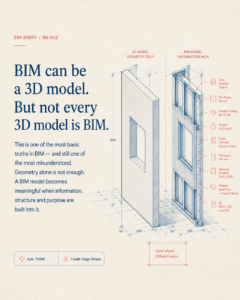
It also reminds us that information need is not only geometry. A component can require a very simple representation and still need rich alphanumeric or documentary information. Another may require precise geometry for fabrication but very little additional data.
Two representations of the same object can therefore both be appropriate — even if they look completely different.
It depends on the use.
A model for spatial coordination does not need the same information as one for fabrication, commissioning or maintenance. This sounds obvious. Culturally, it changes everything.
BIM stops being a competition to build the richest possible model and returns to what it should have been all along: the design of information.
And yet I do not think overmodelling is usually born from bad intentions.
I think it is born from fear.
Fear that we have not modelled enough. Fear of claims. Fear of leaving ambiguity. Fear that someone, somewhere, will ask why a piece of information was missing.
So, just in case, we model it. Just in case, we parameterise it. Just in case, we federate it. Just in case, we ask for more.
But BIM should not work through fear or compulsive accumulation.
It should work through purpose.
And perhaps the most mature BIM decision is not knowing how to model more.
It is knowing what not to model.
That is harder.
It requires experience. Mature information requirements. Clients who understand what they are asking for. Dialogue between disciplines. Trust between parties. And the confidence to distinguish useful detail from ritual detail.
Maybe the future of BIM will not be made of ever larger models.
Maybe it will be made of models that are more deliberate, more interoperable and more agile — containing exactly the information needed, when it is needed.
No less. No more.
Because the goal is not to produce the most impressive digital twin.
The goal is to help real people make real decisions.
And I think that is one of the most important cultural challenges ahead of us: learning to separate useful information from background noise, and necessary detail from detail produced simply to feel safe.
Perhaps mature BIM will not belong to whoever models everything.
It will belong to whoever knows how to choose.
With intention. With responsibility.
And, occasionally, with enough collective courage to say:
“We do not need to model that.”
Sometimes, that is far more professional than increasing detail by default.